Did OpenAI solve the Navier-Stokes Millenium Prize problem?
With the recent announcement by OpenAI that they have found a solution to the Navier-Stokes equations, there has been a lot of misconception, drama, and to some extent, fearmongering going around, depending on who you ask.
Has OpenAI found a solution that will put all CFD engineers, researchers, and end-users out of business? Is this the end of cfd.university? Read on and find out.
In this article
- In this article
- The Millennium Prize: The Navier-Stokes solution
- OpenAI's solution to the Millennium Prize Problem
- Consequences of OpenAI's announcement
- What an analytic solution of the Navier-Stokes equations would mean
- Summary
The Millennium Prize: The Navier-Stokes solution
In the year 2000, the Clay Institute unveiled a prize bounty: solve any of the 7 unsolved mathematical problems, and they make you a millionaire! In the year 2000, that was an eye-watering amount of money; in the year 2026, that gets you about a pint of milk and a cinnamon roll after you have paid off your electricity bill in the UK (with the government rolling out subsidies to pay your electricity bill, because we live in a functioning first-and-a-half-ish-world country).
Amongst the 7 problems is one that is of particular importance for us: the Navier-Stokes equations. Since 2000 and the time of writing of this article (opinion-piece?), 1 Millennium Prize problem was solved by a Russian mathematician who refused to become a millionaire. What a legend. 6 problems remained open. That is, until the 8th of September 2026, when OpenAI dropped an announcement that they had solved one of them. The Navier-Stokes problem.
To understand what OpenAI actually did, let us first understand what the Navier-Stokes Millennium Prize actually entails. It may be different from what you think it is. The official problem description can be read here.
Simply put, we have an incompressible fluid that is governed by the Navier-Stokes equations. The momentum equation is given as:
The continuity equation is given as:
Both equations are required to hold at any location and for any time , which is formulated in the original problem as:
Now, it is actually incredibly simple to solve these equations if you have some creativity (or lack thereof?!). For example, the simplest solution to these equations in three dimensions is:
Plug that in, and you will get for both equations. Problem solved; where is my million dollars? I want to make a cringe-worthy YouTube video, too, like Linus Tech, where I buy my own private jet and then keep reassuring everyone that I am not a spoiled wealthy kid on the internet.
To avoid loophole-finding Germans claiming the prize, the Clay Institute put in a few restrictions to stop my private jet travelling dreams (party poopers ...). This is what the Millennium prize describes as a physically reasonable solution. Equation 6 in the problem description requires:
This means, in plain English, that both and have an infinite number of derivatives (i.e. we are dealing with a smooth function); i.e. the following derivatives exist:
The same holds for the velocity derivatives of , , and at every time . So, if you throw in a shock wave, your derivatives are not continuous; any step-change in a function would not be a permissible solution.
The second requirement is given by equation 7 in the problem description, and we have:
This states that when we integrate the squared velocity field (i.e. the kinetic energy per unit mass) over the entire domain in at any point in time, it will always remain below a constant C (that is, we will not accumulate kinetic energy and it will not march to infinity; instead, the energy is bounded to a specific level).
Now we get two additional constraints. The first one is:
It's a bit convoluted, but in a nutshell, it states that any derivative of , , and with respect to any coordinate direction , , and , including combinations (i.e. mixed derivatives), vanishes at infinity.
Let's unpack that statement a bit more. The first one is about the derivatives. We require any spatial derivative to go to zero at infinity. For example, any of the following derivatives is targeted by this expression:
Then we require that all of these derivatives vanish as we march towards infinity, i.e. , , and become positive or negative infinity. The reason we need this statement is so that we don't simply add an infinite amount of energy somewhere at infinity, which can then later creep back into the equations and then feed them with energy.
Imagine the following scenario: it is 1992, you sip on your cup of coffee (or, preferably, tea), and then your neighbour conducts some nuclear bomb explosion test in their garden. Now, let's assume your neighbour is the US military and they are a few miles down the road. You can't see them; you can't hear them; heck, you are not even supposed to know they exist. For all you care, you don't have any neighbours, and the closest neighbour lives about an infinite distance away from you.
Now, they do their little experiments, you know, detonating a 20-kiloton nuclear bomb in their garden (all in the name of science). Even though they live an infinite distance away from you, the energy from the blast will surely knock off your carefully arranged napkins on your table (and, perhaps, also destroy your windows and spoil the curtains a bit, but, I mean, you decided to live next to the US military so you probably have a window and curtain subscription to replace them on the regular).
That is, essentially, what we are dealing with. To avoid an infinite amount of energy being placed somewhere at infinity, we require all derivatives to decay to zero as we approach infinity. If you are thinking that all derivatives have the form of a bell-shaped curve, as shown in the following picture, you have a good-enough mental picture.
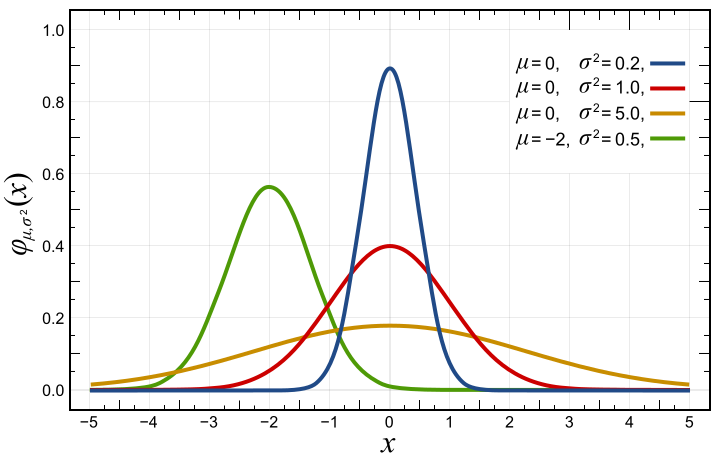
The second requirement is now for a forcing term . If we wanted to use such an external force, we would need to satisfy the following requirement:
In a nutshell, it is the same requirement that we stated before, now expressed for the force. The force cannot be infinitely large at infinity (which would allow the same feeding of energy back into the solution). There is also a second requirement that the force has to decay as the time increases. So, it is also not permissible to start with a smooth force and then simply increase the force to infinity as time progresses.
So, to recap, we have:
- The Navier-Stokes equation in incompressible form.
- The requirement that all derivatives are continuous for and .
- The energy is bounded and stays below a certain constant .
- The derivatives of velocity vanish at infinity.
- The forces vanish at infinity and as time progresses.
These 5 statements are now used to create 4 specific formulations of the Millennium Prize. If you can solve any of these 4 formulations, you will be able to collect your 1-million-dollar prize money. These statements are as follows:
A - Existence and smoothness of Navier–Stokes solutions on
For a three-dimensional, viscous fluid (that is, one where the viscosity is greater than zero), where all derivatives of the initially supplied velocity field vanish at infinity, with no external forcing, there exists a smooth solution for and everywhere in the domain and time. Essentially, this means we have an analytic solution for the Navier-Stokes equations.
The value of an analytic solution within the context of the Navier-Stokes solution cannot be overstated. It would mean a general step change in our understanding of fluid mechanics; we would be able to analyse flow patterns in ways we could not do before, and we would likely see a third discipline within the field of fluid dynamics, i.e. next to experimental fluid dynamics and computational fluid dynamics, we would also have analytic fluid dynamics, or AFD (an unfortunate acronym).
B - Existence and smoothness of Navier–Stokes solutions in
This is the same problem as A, but it assumes a bounded domain with periodic boundary conditions (think: homogeneous decaying turbulence in a box). This avoids having to deal with derivatives at infinity and makes the problem somewhat easier to deal with.
C - Breakdown of Navier–Stokes solutions on
For a three-dimensional, viscous fluid (that is, one where the viscosity is greater than zero), where all derivatives of the initially supplied velocity field vanish at infinity and with an external forcing which also vanishes at infinity (both space and time), there exists no solution for and .
This is a bit more nuanced. So, if you can show that an initial solution you provide of , together with a forcing term (that decays over space and time), produces a so-called singularity, you have shown the breakdown of the Navier-Stokes solution. A singularity exists when either a flow variable or its derivative becomes infinitely large.
It is important to understand that a solution of this kind would simply point out that there are special cases in which the Navier-Stokes equation no longer holds true. It doesn't mean that the Navier-Stokes equation is no longer valid; it still works for the majority of flow scenarios. Airplanes wouldn't suddenly fall out of the skies; our aerodynamic calculations based on the Navier-Stokes equations would still be correct.
It just means that there are circumstances where the Navier-Stokes equations are incomplete, not incorrect. That is an important differentiation. So, finding a case where the Navier-Stokes equations break down (pointing at an incomplete set of equations rather than invalidating them) is much simpler than providing an answer to the first problem (A and B), i.e. showing that an analytic solution for the Navier-Stokes equations exists.
D - Breakdown of Navier–Stokes Solutions on
This is again the same as problem C, allowing for periodic boundary conditions.
OpenAI's solution to the Millennium Prize Problem
Now that we understand what the Navier-Stokes Millennium Prize is and isn't, let us now look at the solution OpenAI claims to have found. At the time of writing, there is still an intense review of their solution, with some already pointing out some shortcomings. However, for the sake of this discussion, I will assume that their solution is genuine and that any shortcoming can be overcome. I want to provide context on what their solution means, specifically for us CFD practitioners.
OpenAI's press release is fairly short, and they give us a good idea of what they have actually done. I quote:
Our system produced an analytical proof and a Lean formalisation that an initially smooth fluid at rest can develop a singularity in a finite time. The fluid has a smooth force applied to it, and its energy remains finite through the entire dynamics, from rest to the formation of the singularity. This resolves the Navier–Stokes Millennium Prize problem by establishing statement "C" (and also "D") in the official Millennium Prize formulation.
The take-away message here is that OpenAI has not solved the Navier-Stokes equation in the context most people would believe when they first heard about OpenAI's announcement. They have shown that the equations break down, and that they are incomplete, not incorrect. They have found a solution to problems C and D in the Millennium Prize Problems, but we have no further understanding in terms of an analytic solution.
The much more interesting problems are A and B. Perhaps a proof for those will be provided at some point, though I doubt OpenAI will take another shot at the problem. Why? An estimate by researchers at the University of Michigan shows that it would cost about 6 million dollars should you or I try to do the same proof through OpenAI's API pricing (if we had, indeed, their latest model already available).
Now, obviously OpenAI does not pay itself, though they would still need to pay for compute resources. The same researchers put their total cost at about 1 million dollars. That is the same prize money the Clay Institute is offering for the solution of the Navier-Stokes equation.
So, what fluid solution have they investigated that shows the equation blows up? They describe that as well in their press release:
The solution is a vortex, a spinning swirl of fluid, that spirals inward and gets increasingly elongated, like spaghetti. This central region shrinks while it speeds up in such a way that its energy still stays finite, as required by the laws of physics.
Does that sound familiar? Essentially, what they are describing is how any turbulent flow starts. That is, we have some disturbances (e.g. surface roughness at walls, free-stream disturbances like gusts) that introduce some highly energetic and stochastic motion into our flow. Viscosity may or may not be sufficient to damp these motions up to a critical point. After that point, turbulence takes over, and we have a stochastic flow field.
In turbulence, we know that there are scales associated with our fluid that describe the smallest length, velocity, and time scales. These are known as the Kolmogorov length scales, not to be confused with Kolmogorov the user on Snapchat, which used to be my handle (Snapchat has now deleted my account; I wonder why). I've also used the handle Rusanov on my Ubisoft account, so if you ever encountered a Riemann solver in Watch Dogs 1 and 2, you likely got hacked by me.
We know that our Kolmogorov length scale, for example, has a finite value, and it is determined entirely by the viscosity and dissipation. For the length scale specifically, we have:
A singularity means we have ever-increasing values for our primitive variables and their derivatives. Another way of looking at that is to say that our smallest scales (e.g. our length scale) go to zero.
From the Kolmogorov length scale definition, we can see that the viscosity is in the denominator. It cannot go to zero, as the Millennium Prize specifically requires that . So, the only way for the length scale to march to zero is by the dissipation becoming infinitely large. And, if we look at its definition, we have:
According to OpenAI's solution, they have found a vortex that stretches indefinitely (they used the highly scientific term like a spaghetti, though, I still insist that the singular of spaghetti is spaghetto (perhaps this is another inconsistency in their proof?!)). So, at the spaghetto core, the velocity gradient will increase without bounds, and so, the dissipation becomes . With that, we have:
We can also look at the Kolmogorov time scale, which describes the turnover time for a turbulent eddy. It is given as:
Again, with , we have a turnover time of zero; everything happens at once. However, and aren't physically correct solutions, and this is important to understand for our discussion. We need to step back a bit to understand why.
The Navier-Stokes equations are derived based on a few assumptions. We assume holds true. We should not forget that this is an axiom. An axiom is an accepted truth without proof, like stating that tea is a far superior beverage compared to coffee. We do not need proof of this, and we do not question this either.
One more assumption is that the Navier-Stokes equation describes a continuum, i.e. we are dealing with the collective behaviour of particles, rather than the behaviour of individual particles. There is one non-dimensional number we use here to describe that, and that is the Knudsen number . Wikipedia describes it as not to be confused with KN number, used by United States for describing North Korean missiles. Literally the first sentence.
A better definition is that it is the ratio of the mean free path to a characteristic length scale :
The mean free path is the distance a particle travels before it hits another particle. For air at room temperature, for example, we have . So, if you are investigating anything that has a length scale of the order of meters, your North Korean missile Knudsen number is about . We say that the continuum hypothesis starts to break down once we have , approximately (it is a gradual breakdown over a range of Knudsen numbers).
So, what does that mean for our current discussion? If we set the length scale now to , i.e. the turbulent length scale according to Kolmogorov, then we can see that is not possible. can never become smaller than our mean free path. If we insert that into our Knudsen number definition, we have:
So, once becomes about the same order of magnitude as (once the Knudsen number approaches unity), the continuum hypothesis breaks down and no longer holds. Applying the Navier-Stokes equations here is nonsensical; they are simply not defined here, and so we say that they break down.
So, another way of thinking about this breakdown is not to think in terms of are the Navier-Stokes equations incomplete but rather do they allow for solutions that are outside of their own defined operating window. OpenAI is claiming that they have found that, and that is very different from having found an analytic solution.
Consequences of OpenAI's announcement
Now, let's look at some of the consequences. First of all, as many in the field of mathematics have pointed out (and, hopefully, with the discussion provided above, something that you can follow), the proof OpenAI is claiming to have produced is of little use by itself. The point of having an answer to any of the 4 problems outlined in the Millennium Prize (A-D) is not the proof itself; it is the knowledge of how we got there and what we can learn from it.
Knowing that the Navier-Stokes equation is incomplete is not news. We know that. I have just shown you that with Knudsen numbers around unity, the Navier-Stokes equations do not hold up anymore. The much more interesting thing is how the Navier-Stokes solution breaks down. While OpenAI has dumped their proof on a GitHub repository and used Lean, a tool for checking that a proof is formally consistent (it does not check if it is correct; it can't), they have made no attempt to decipher what their agents found.
But that is exactly what we as scientists want to know. So now we have to reverse engineer an understanding of what their collective 10,000 agents produced. We have to check it for correctness; OpenAI has no intention of helping with that either. While we can (and will) look at their proof and learn from it, my biggest concern is with OpenAI's motivation.
At the time of writing, OpenAI is burning through billions of dollars every quarter. They are about to go public with an eye-watering valuation at the stock market. OpenAI needs big headlines to justify its valuation. Is there a better headline than claiming to have solved one of the Millennium Prize Problems? A problem that mathematicians could not solve in the past century and took their model only 88 hours to crack?
Yes, as a headline, that is impressive. From a scientific point of view, they have provided no immediate value. They claim to the outside world that they have the capabilities to solve problems we humans seemingly can't (at least not as fast as them), but they are also hiding the fact that they burned through about 1 million dollars in computational resource costs.
I do think it is important that we start to look at cost. Arguably, solving the open question of the Navier-Stokes problem is a good one to solve, but that came at the cost of 1 million dollars in hardware utilisation, or just about ~$11,000/hour, given that it was taking OpenAI 88 hours to solve this problem. So, let's reverse engineer some numbers, shall we?
OpenAI used Nvidia's H100 and H200 GPUs for training, according to this highly scientific reference (which we shall all cite going forward in our scientific studies), and likely Nvidia's Blackwell (Ultra) GPUs for inference. As best as I can tell, that is an LLM inference chip, based on how it is described and presented by Nvidia.
So, let's go with Always Ultra (I mean Blackwell Ultra, easy to confuse the two), it has a total graphics power (TGP) of 1.4 kW. Looking at energy rates in the US, where OpenAI's data centers are located, we can find rates as cheap as 10 cents/kWh. Given that is OpenAI's number one cost, I am sure they build their data centers in areas with the lowest energy costs. Let's assume they pay 10 cents/kWh, for the sake of argument.
EnergyBot puts the average CO2 produced at 0.4 kilograms for every kWh of electricity produced. So, with these numbers, we can do some calculations. $11,000 buys you 110,000 kWh at 10 cents per kWh. 110,000 kWh is enough to run ~78,500 Blackwell GPUs, each containing 288 GB of RAM. OpenAI also states they used about 10,000 agents, so about 8 GPUs per agent. That number seems realistic for running one instance of ChatGPT per agent.
Now, 110,000 kWh used means kilograms of CO2 produced each hour. For 88 hours, that is just shy of 4000 metric tons of CO2 produced. The Boeing 787 Dreamliner produces about 16 metric tons of CO2 each hour it flies. That means we could fly for 250 hours to produce the same amount of CO2. At a speed of approximately 900 km/h, we could travel as much as 225,000 km. That is about 5 times around the world.
This is one company using its own model for 88 hours, for one problem. Now scale that to billions of users who use LLMs with important prompts like:
write a biblical verse in the style of the King James Bible explaining how to remove a peanut butter sandwich from a VCR
I bet at least a few will have dropped that prompt into their favourite LLM before even reading this sentence. Greg Smith has a nice analogy for the cost of LLMs:
This figure [referring to the CO2 released by GPT3, based on 2023 data] is approximately the same emissions as two or three full Boeing 767s flying round-trip from New York City to San Francisco. [...] Continuing our earlier analogy, instead of two or three full Boeing 767s flying round-trip from New York to San Francisco, current provision of consumer LLMs may be more like a Boeing 767 carrying one passenger at a time on that same journey.
And that is often overlooked. LLMs are fantastic search engines, but have a horrible CO2 footprint when compared to, well, a search engine. LLMs are good at pretty much anything you throw at them, until you remember that there are dedicated tools that do the same at a fraction of the cost (and environmental footprint).
OpenAI is not releasing any internal cost calculations showing how much CO2 they are releasing. And they are incentivised not to. Solving a century-old math problem using AI is a fantastic headline. Actively working against the COP21 Paris Agreement, ensuring global temperatures will not rise by more than 2 degrees Celsius compared to pre-industrial levels, would make for a very different headline, don't you think?
Let's not think too much about how much CO2 we use when asking ChatGPT what the weather is like today. Of course, if you disagree with the weather forecast and wish it were a bit warmer today, keep spamming ChatGPT and repeatedly ask it what the weather will be. If you do it long enough, it will get warmer.
Then, of course, there is the controversy itself. There are allegations by Tristan Buckmaster of the Courant Institute at NYU, who claims to have worked on the problem before, using OpenAI's Codex and Anthropic's Claude. In his words, he and collaborators (from Anthropic) were working on a proof, had something and were planning to publish it. They got to know that OpenAI was suddenly working on it as well.
Buckmaster accuses OpenAI of looking at his chat logs with Codex to inform their own solution-finding process, something OpenAI denies. They left the door open, though, by saying that whatever inputs users provide may be used for training. As it so happens, they were in the process of training their latest model, which was used to find the proof they have published.
Before OpenAI published their statement, Buckmaster and they were in contact. OpenAI offered sole authorship to Buckmaster for the solution, but only if it would exclude researchers at Anthropic and if the proof would state that only OpenAI products (Codex) were used.
Of course, if the headline was "OpenAI and Anthropic solve Millennium prize problem", that would be bad press. It wouldn't boost stock prices as much. And, even if Buckmaster made all of this public, pointing out the questionable practices at OpenAI, the mainstream media will likely not cover that aspect and instead focus on "the Navier-Stokes equations are solved and done" without trying to understand the actual problem they have solved in much more detail.
If I had to summarise the work OpenAI did, it is this: If their solution turns out to be correct, they genuinely have made real progress in the field. They have shown something we could not do for the past century. While they have given us little support in analysing their proof (they have already stated they have no interest in claiming the prize money, because that would require genuine scientific effort and additional work), we can still learn from it.
However, even if we have done that, we may understand the Navier-Stokes equation a bit better; we may understand its limitations a bit better, but it would not change anything for you and me doing CFD. There will be lessons learned, but these will be mainly on the mathematical front that are unlikely to spill over into everyday CFD usage. At least that is what my gut is telling me based on the current state (my gut's IQ isn't that high, take it or leave it).
What an analytic solution of the Navier-Stokes equations would mean
Now that we have looked at what OpenAI has actually produced (well, using a bird's-eye perspective anyway), let's start dreaming a bit. What if someone actually solved problems A and B of the Millennium Prize Problems? What if we had an analytic solution available? How would that impact us in the field of CFD? Let's make our very own xkcd What If? style article and think about what an analytic solution would actually mean.
When I was a graduate student, I was looking into research on analytic solutions of the Navier-Stokes equations. Now, I am an engineer by training, not a mathematician (that hasn't changed), so I was more interested in the question will there ever be an analytic solution? I just decided to specialise in CFD, and I was going all-in on that subject, so I thought I'd evaluate the field before committing to it.
I was no different to any experimentalist in the 1950s who was looking at this new field called computational fluid dynamics that, presumably, was promising to replace experiments in the future. Well, almost 80 years later, people are still trying to get rid of wind tunnels, but somehow they are still here. And, 80 years later, CFD engineers know that we would be pretty bad at doing our job without grounding our work in experiments. Without any experimental validation data, CFD would not be credible as a tool.
Experimental and computational scientists/engineers have found a way to coexist. So, what if we had an analytic solution available now? Would the analytic scientists/engineers put us experimentalists/computationalists (is that even a word?!) out of business?
I don't think it will. It is likely that we will rely less on experiments and more on analytic solutions, but again, remember that the Millennium Prize Problem is for incompressible flows, and there are a bunch of flows that would still not be captured by this.
An analytic solution of the Navier-Stokes equations would simply mean we get an equation that computes the velocity and pressure field for a given set of initial and boundary conditions. That's it. What do we do in CFD? Well, the same, but since we don't know the exact analytic solution, we approximate it. However, we still make that solution subject to our initial and boundary conditions.
An analytic solution would simply replace a Taylor Series approximation or a flux evaluation at faces. It would make the internal machinery a lot easier. The only thing that changes is that we can replace all of what is approximated by an exact solution; that's it. Everything else remains the same. We would still be running CFD solvers, now evaluating a much cheaper analytic solution. And that has several consequences.
For starters, an analytic solution is local, i.e. it does not depend on neighbouring cells. Thus, parallelising a CFD simulation becomes trivial. There are practically no communications across inter-processor boundaries, and so, even a pretty bad CFD solver would still show rather impressive scaling behaviour.
If we look at the grids we use, we would no longer be talking about structured and unstructured grids. On structured grids, we can always go to a neighbouring cell in a deterministic way; we lose that structure on an unstructured grid (hence its name). Since an analytic solution can be evaluated without the need for neighbouring points (we only need them currently to approximate gradients over space), we don't need cells or connectivity tables. We simply have coordinates, and that is all we need.
Grid generation will become trivial. Any random number generator will do, although one that gives a uniform spacing, or clustering towards boundaries, is likely to be preferred. But, if we really wanted, we could write a mesh generator in a few lines of code. Add a bit of boundary handling, and you could handle pretty complex cases as well.
We may still need to clean our CAD data for dirty CAD or CAD models that are too complex, but at least the meshing would be trivial from that point onwards. No more negative volume cells generated, no more non-manifold errors, and no more inflation layer settings that crash our volume mesh. In fact, mesh quality, a topic I am known to be particularly picky about, is one that will no longer be of importance. Mesh quality measures the quality of elements/cells, which would no longer exist.
In its place, we would be looking at point cloud distribution properties, i.e. how well, evenly, clustered, etc. points are filling out the space. Or, perhaps we go fully Lagrangian, discretise a set of particles and then simply evaluate the Navier-Stokes equations using a meshless approach. I doubt it, but certainly there would be research on meshless methods. I mean, if we can get rid of the approximations, why keep the mesh (or rather, coordinates) around?
Time stepping would be removed entirely. We simply state at what point we want the solution. However, that would simply give us one snapshot in time. One of the advantages of RANS modelling, for example, is that we use here a time-averaged view of the results, and that is likely what we would like as well from an analytic solution.
So, we could still evaluate the Navier-Stokes equations at discrete points in time and then average them in time to get a better idea of what the flow would look like in a time-averaged sense, which is typically what we want. We may also want to evaluate the Navier-Stokes equation at discrete points in time if we are interested in the time-history itself; think vortex shedding around a cylinder and its corresponding lift and drag coefficient vs. time plots.
If we think about the cylinder example further, if all we ever wanted were the lift and drag coefficient plots, well, we would only need to compute the flow on the cylinder itself (i.e. the pressure field and velocity gradients). There would be no need to compute the solution everywhere in the domain. That would make for a pretty cheap computation.
If we look then at the time stepping, we wouldn't need to consider any CFL number. There are no implicit or explicit time integration schemes. The CFL number is a numerical stability limit, which would vanish if we used an analytic solution. We would simply set our time step size based on the frequencies we want to resolve.
Another artefact that would vanish is the residuals. They tell us how little the solution is changing from one step to the next. Since we know the exact solution, there are no more residuals. Every calculation is exact.
The really interesting part is turbulence modelling. Currently, we have four major categories of turbulence modelling:
- No modelling at all (Direct Numerical Simulation, DNS)
- All turbulence modelled (Reynolds-averaged Navier-Stokes, RANS)
- Smallest scales modelled (Large Eddy Simulation, LES)
- Hybrid RANS-LES (DES, SAS, SBES, etc.)
The amount of turbulence we would resolve would not be dependent on a model selection we make at the start of our simulation, but rather based on the density of points we place in our computational domain. If we place them close enough to resolve the Kolmogorov length scales, well, then we get DNS-like resolution. If we make it coarser, well, it is still DNS, but a pretty bad one. Average those results over time, however, and you get RANS-like results.
The exciting part about this is that we can have RANS, LES, and DNS-like resolution within our flow, at the same time, based entirely on the point spacing and time averaging that we apply to the solution. We could also dynamically change that by using an adaptive point insertion/removal algorithm. Since resolution alone determines the amount of flow features we can resolve, switching between any formulation would become pretty cheap (of course, we need a suitable time step as well).
There is, however, also one downside, and it is one that is not immediately obvious. An exact solution is only exact in terms of the boundary conditions and initial conditions we provide. Once we are uncertain about our initial and boundary conditions, we will see that uncertainty propagate into our simulations.
That is the age-old problem we have in DNS and LES already, where imposing realistic boundary conditions is a real challenge. This problem will only be amplified by an analytic solution.
For example, let's think about an airfoil at a Reynolds number of about 100,000. At that point, transition from laminar to turbulence can be observed when looking at the skin friction coefficient. Would we see the same behaviour from an analytic Navier-Stokes equation? I don't know, but I have my reservations. The transition from laminar to turbulence depends a lot on the boundary conditions, e.g. surface roughness.
In RANS models, we get rid of these dependencies by modelling them. This leaves us with the problem that our RANS models only really work well for cases they have been calibrated for (and it is also the reason why your NACA 0012 simulations are pretty good regardless of which RANS model you use, because that is a classical calibration case). They can be catastrophically wrong for cases they have not been calibrated for.
Surface roughness is a microscopic effect that propagates from the smallest scales up to the largest. How would you impose that? Is that something the continuum-based Navier-Stokes equation can even capture?
I find it highly likely that the analytic Navier-Stokes equation will be used primarily for generating a velocity and pressure field, but there may then still be models placed on top of that, just as we do these days with CFD, and these models will add additional predictability to the Navier-Stokes equations. If you want, that could be regarded as a hybrid model where we mix models with the exact solution.
All predictions are based on my best understanding of how CFD is done today. Your experiences may differ, and so you may have different views. That is OK; just like LLMs, TomGPT does hallucinate as well from time to time.
Summary
Where does this leave us? While I have been critical in this article of OpenAI's findings, I want to stress that any advancement in the field of fluid dynamics, be it AI- or human-led, is of value, and I welcome those. I just don't agree with OpenAI's motivation and execution.
Apparently I am not alone; the Association for Human Mathematics (AHM) is a coalition of mathematicians that "protects mathematics as a human endeavor against the threat of artificial intelligence". Furthermore, they state: "We work to maintain the independence of the mathematical community from the encroachment of corporate interest. In light of the grave societal, environmental, and economic impacts of the AI industry and the threat of unfettered AI growth, we strive not to be complicit."
While this sounds good on paper, it also sounds a bit like an Amish-style movement. People were opposed to PCs as well when they were introduced; imagine where we would be nowadays if scientists collectively agreed not to use PCs in the field of CFD. If you are working in the field of science, you need to be adopting the latest tools and methods available to you; if you don't, others will, and they will make your research redundant.
Apparently, some members of the AHM have openly stated that they would not use any form of AI in their research. For me, this fails what I call the airplane paradox.
Airplanes produce a sizeable amount of CO2. If we got rid of airplanes, we would reduce global warming noticeably. Would you be able to live in a world without airplanes? Before you answer, don't just consider your personal travel preference; consider all the stuff you would not be able to get quickly that is imported by air. Would you be OK to order something on Amazon with a 3-month delivery time?
In my view, we have worked hard in the past to make air travel a reality. Instead of closing our eyes and pretending airplanes don't exist, or claiming we improve the climate by not travelling as much by air, we should embrace it. We should be looking at all of the problems that come from air travel and try to fix those. That is the cycle of human progress. Specifically, we should be researching climate-neutral propulsion systems, and people do.
So, instead of turning away from a technology and saying "well, I am not using it, so it is not my problem", that is probably the worst you can do. If you have a problem with AI, well, use your efforts and skills to fix it. Simply joining an association and saying I am against AI (they may as well say I am against progress) will not solve the issue.
Yes, I am against companies using AI to pretend to solve problems that they don't care about, just to generate a headline. But how many companies are engaging in this? Well, to date, only OpenAI, as best as I can tell. They have solved one problem (maybe?!), they got their headline, and they added value to their company to drive up their stock prices.
I don't see this as a big threat to the scientific community (just yet). Things may change, but what is the commercial interest in other companies joining the field and solving scientific problems? The value proposition is pretty bad, so I don't expect many more attempts like this. OpenAI was there first, and that is all we will remember.
We all probably know that the Wright brothers were the first to fly. Can you name the second person who took to the skies successfully after the Wright brothers? No, you can't, because no one bothered to record that. If you look at historical notes, there is no consensus. OpenAI took all the glory; there is no prize or fame for coming second. So, I doubt there will be a lot of "encroachment of corporate interest" in the scientific field.
In any case, OpenAI's solution to the Millennium Prize is an impressive headline, and for the moment, nothing more. My hope is that we can learn enough from the proof so that a solution to the Millennium Prize, specifically, problems A and B, i.e. an analytic solution, will become feasible. I would love to be writing analytic CFD solvers and stress-testing how far we can push an analytic solution before it starts to break down.
We should all be hoping for an analytic solution of the Navier-Stokes equations. It truly would revolutionise the field of CFD, and not make it obsolete. Experimentalists, CFD practitioners, and users of the analytic solution to the Navier-Stokes equations would all happily coexist and solve problems which are just out of reach these days. That is an exciting thought to have, and I hope to live long enough to see that become a reality!
Who am I kidding? This is the age of AI. It will probably be found in the next 5 minutes. Go ahead. Ask ChatGPT if a solution has been found, and make sure to press F5 repeatedly. Oh, but do install air conditioning before; you will need it.

Tom-Robin Teschner is a senior lecturer in computational fluid dynamics and course director for the MSc in computational fluid dynamics and the MSc in aerospace computational engineering at Cranfield University.